

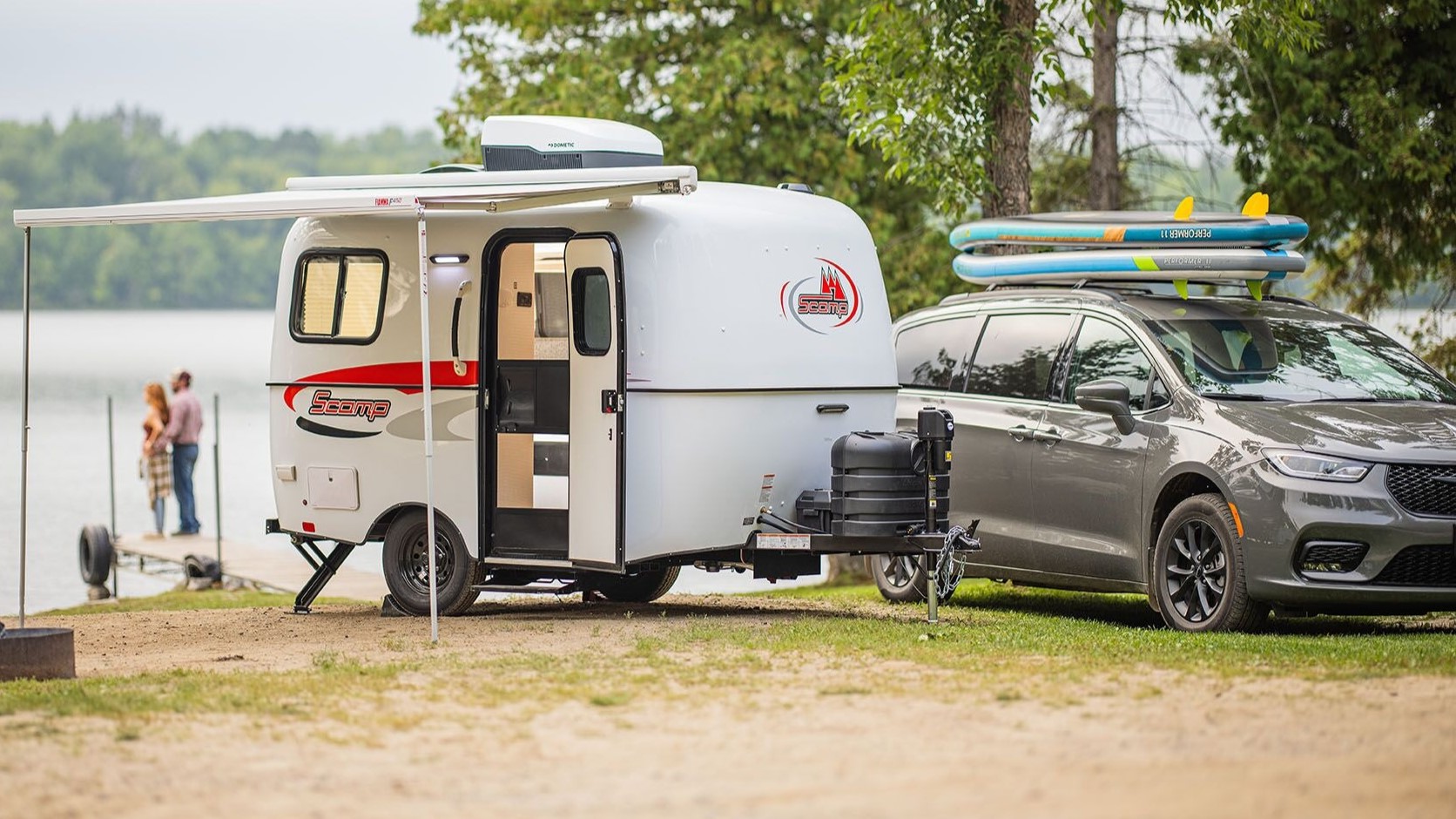
Automotive commercials love to show midsize crossovers and half-ton trucks hauling heavy loads up steep mountain passes with effortless ease. When shopping for a compact travel trailer, teardrop, or lightweight pop-up, it is easy to glance at your vehicle’s advertised maximum tow rating, see a number like 5,000 or 7,000 pounds, and assume a 3,000-pound camper will be an easy pull.
That assumption catches thousands of well-meaning campers off guard every year. Maximum tow rating is rarely the number that dictates what you can safely tow. In almost every real-world scenario involving small to midsize tow rigs, payload capacity and Gross Vehicle Weight Rating (GVWR) serve as the true physical ceilings. Overlooking these metrics does not just strain your engine and transmission; it compromises braking, degrades steering stability, and creates dangerous handling conditions on the highway.
Understanding how vehicle weight ratings interact ensures your setup remains stable, legal, and comfortable to drive over long distances.
The Tow Rating Illusion
Vehicle manufacturers highlight maximum towing capacities in their sales brochures, but those figures represent a carefully engineered baseline. That advertised rating typically assumes a completely empty, base-model vehicle carrying nothing more than a 150-pound driver, a full tank of fuel, and zero cargo.
As soon as you invite family members along, load luggage into the back, mount a bike rack, or bring the family dog, that theoretical towing capacity shrinks. Towing is not simply a matter of what an engine can pull horizontally along a flat road. The more critical mechanical challenge is what the vehicle’s chassis, suspension, tires, and braking system can support vertically while maintaining directional control.
This vertical burden is where payload and GVWR enter the equation, and it is almost always the first threshold you cross when hitching up a small camper.
Core Weight Ratings Defined
Navigating the specifications stamped onto vehicle door jambs and trailer frames requires familiarity with a handful of standardized industry ratings.
Gross Vehicle Weight Rating (GVWR)
The Gross Vehicle Weight Rating (GVWR) is the maximum operating weight of a vehicle as specified by the manufacturer. This is a rigid mechanical limit, not a flexible suggestion. It accounts for the structural strength of the vehicle’s frame, the load-bearing limits of the axles and suspension springs, the heat dissipation capability of the braking system, and the load index of the factory-installed tires.
Every vehicle has its own GVWR:
-
Your tow vehicle’s GVWR encompasses the curb weight of the vehicle itself, all passengers, all aftermarket accessories, everything packed in the cabin or cargo bed, and the downforce exerted by the trailer onto the hitch.
-
Your trailer’s GVWR represents the absolute maximum the camper can weigh when fully packed with water, propane, batteries, food, clothing, and outdoor gear.
Exceeding the GVWR means operating the vehicle outside its certified engineering limits, which increases stopping distances, accelerates component wear, and can void your insurance coverage in the event of a collision.
Curb Weight vs. Dry Weight
To determine how much weight you can add, you must understand your starting point.
-
Curb Weight refers to the actual weight of your tow vehicle sitting on the dealer lot with all standard equipment and a full tank of fuel, but without any passengers or cargo inside.
-
Dry Weight (often labeled Unloaded Vehicle Weight or UVW on RV specification sheets) is the weight of the camper as it rolled out of the manufacturing plant. Crucially, dry weight almost never includes dealer-installed options, the heavy battery on the tongue, filled propane tanks, or fresh water. Relying on dry weight when calculating your towing margins is a common mistake that leaves campers unexpectedly overweight before they even pack their first duffel bag.
Payload Capacity: The Real Gatekeeper
Payload capacity is simply the total weight a vehicle can carry inside and on top of its own structure. The basic formula is straightforward:
Payload Capacity = GVWR – Curb Weight
Payload includes the driver, every passenger, aftermarket floor mats, roof racks, coolers, luggage, and tools. Most importantly, it includes the tongue weight of your trailer. Because payload is consumed so quickly by everyday items, a vehicle rated to pull 5,000 pounds can easily exceed its payload capacity with a trailer that weighs only 3,200 pounds.
The Mechanics of Tongue Weight
A bumper-pull trailer does not carry all of its own weight on its own axle. To remain stable and resist violent aerodynamic sway at highway speeds, a conventional bumper-pull camper must place between 10% and 15% of its total loaded weight directly onto the hitch ball of the tow vehicle. Twelve percent is widely regarded as the target sweet spot for balanced handling.
This downward force is known as tongue weight. The moment you drop the trailer coupler onto the hitch ball, that tongue weight transfers entirely to the tow vehicle. It acts as cargo carried by the tow vehicle’s rear axle and directly consumes your vehicle’s available payload capacity, pound for pound.
If your small camper has a loaded weight of 3,500 pounds, a 12% tongue weight exerts 420 pounds of direct downward force on your hitch. Add a heavy-duty weight distribution hitch assembly, which typically weighs between 60 and 100 pounds, and you are using roughly 500 pounds of payload before anyone sits in the front seat.
A Realistic Small-Camper Weight Breakdown
To see how these ratings work together in practice, consider a typical setup: an active family of four driving a popular midsize SUV or midsize pickup truck, towing a modest 18-foot single-axle camper.
The Tow Vehicle Profile
-
Advertised Tow Capacity: 5,000 pounds
-
Payload Capacity (from the door jamb sticker): 1,250 pounds
-
GVWR: 6,000 pounds
The Small Camper Profile
-
Manufacturer Advertised Dry Weight: 2,800 pounds
-
Camper GVWR: 3,800 pounds
-
Actual Loaded Weight for a Weekend Trip: 3,400 pounds (camper + 2 full 20-lb propane tanks + 1 deep-cycle battery + 15 gallons of fresh water + food and gear)
Calculating the Payload Burden
-
Trailer Tongue Weight (at ~12.5% of 3,400 lbs): 425 pounds
-
Weight Distribution Hitch Assembly: 75 pounds
-
Total Hitch Burden on Tow Vehicle: 500 pounds
Now examine the weight inside the tow vehicle:
-
Two Adults: 330 pounds
-
Two Children: 150 pounds
-
Family Dog: 60 pounds
-
Cooler with Drinks and Ice: 45 pounds
-
Cargo (camp chairs, hiking boots, tool kit, stroller): 110 pounds
-
Total Passenger and Cabin Cargo Weight: 695 pounds
The Final Tally
Adding the hitch burden to the cabin cargo:
500 lbs (tongue & hitch) + 695 lbs (passengers & gear) = 1,195 pounds of payload consumed
With a 1,250-pound payload rating, this family has just 55 pounds of margin remaining.
While the trailer’s 3,400-pound loaded weight sits comfortably below the vehicle’s 5,000-pound maximum tow rating, the vehicle is sitting right at its maximum payload and GVWR limit. If the owners mount a rooftop cargo box, install a bed topper, or bring a couple of mountain bikes, they will push the tow vehicle past its certified GVWR, regardless of the fact that the trailer is “small.”
Axle Limits and Combined Weights
Beyond payload and GVWR, two secondary weight ratings require attention when dialing in a towing setup.
Gross Axle Weight Rating (GAWR)
Vehicles have an individual Gross Axle Weight Rating (GAWR) for both the front and rear axles. Because the hitch sits behind the rear axle, trailer tongue weight acts as a lever arm. It presses down on the rear axle while simultaneously lifting weight off the front steering axle.
Even if your total vehicle weight remains slightly under the overall GVWR, an unevenly distributed load or an unassisted rear suspension can push the rear axle beyond its individual rear GAWR. This causes severe rear-end sag, aims your headlights into oncoming traffic, reduces front tire traction, and severely degrades steering responsiveness. A properly adjusted weight distribution hitch helps mitigate this lever effect by transferring a portion of that tongue weight forward back onto the front axle and rearward onto the trailer axle.
Gross Combined Weight Rating (GCWR)
The Gross Combined Weight Rating (GCWR) is the maximum allowable combined mass of the tow vehicle and the trailer together, including every passenger, fluid, and loose item in both. While payload is almost always exceeded before GCWR on small camper setups, checking your total combined scale weight against the manufacturer’s GCWR ensures you are not overtaxing the vehicle’s cooling system and drivetrain on long, sustained highway climbs.
How to Verify Your Actual Numbers
Relying on estimates or online forum spec sheets will not give you accurate numbers. Manufacturing variations, optional trim packages, and accessory installations change the baseline weight of individual vehicles.
Check the Tire and Loading Information Placard
Never rely on the payload figures listed in a general vehicle brochure or online marketing page. Those numbers apply only to the lightest possible configuration of that vehicle platform.
Open the driver’s side door and locate the yellow-and-white Tire and Loading Information sticker attached to the B-pillar door jamb. It contains a specific line that reads: “The combined weight of occupants and cargo should never exceed XXX kg or XXX lbs.”
That number is unique to your exact vehicle as it left the factory assembly line, accounting for every factory-installed option from leather power seats to panoramic sunroofs, all of which reduce your available payload from the base model figure.
Visit a Certified Public Scale
The only definitive way to know where your setup stands is to visit a certified public truck scale (such as a CAT scale found at commercial truck stops). Weighing your setup takes less than fifteen minutes and provides separate axle weights:
-
Pass One: Weigh the tow vehicle and trailer together with the weight distribution system engaged, with everyone on board and a full tank of fuel.
-
Pass Two: Weigh the tow vehicle and trailer together with the weight distribution spring bars disconnected.
-
Pass Three: Weigh the tow vehicle alone without the trailer attached.
Comparing these three weight tickets reveals your exact tongue weight, verifies that neither the front nor rear axles are overloaded, confirms whether your weight distribution hitch is adjusted correctly, and ensures your total vehicle weight stays under the GVWR.
Practical Steps to Protect Your Towing Margins
If your math reveals that you are hovering close to your vehicle’s payload limit, practical adjustments can help you preserve a healthy safety margin:
-
Travel with empty holding tanks. Water weighs 8.34 pounds per gallon. Carrying a full 30-gallon fresh water tank adds roughly 250 pounds of mass to your camper. Unless you are boondocking without water hookups at your destination, travel with empty fresh, gray, and black water tanks and fill up near your campsite.
-
Pack heavy gear over the trailer axle. Placing heavy cargo far forward on the trailer increases tongue weight dramatically. Placing it too far behind the axle can induce violent trailer sway. Storing heavy items low and directly centered over the trailer axle keeps the tongue weight percentage within the ideal 10% to 15% window without overloading your tow vehicle’s hitch.
-
Move cargo from the tow vehicle into the camper. If your tow vehicle is close to its payload limit but the camper has surplus capacity under its own GVWR, shift dense items (such as toolboxes, canned food, and heavy camp gear) from the vehicle cabin into the trailer, centered over the axle. This removes that weight from your vehicle’s payload while keeping the entire rig balanced.
Treating payload capacity and GVWR as non-negotiable boundaries keeps your small-camper road trips safe, reduces mechanical wear on your vehicle, and gives you complete confidence behind the wheel no matter what terrain the highway throws at you.

Comments are closed.